
It’s fun having beer on tap in the house. We have a Komos three tap Kegerator. It was a heavily discounted return acquisition from More Beer. We think perhaps it was returned because it’s a bit noisy during cooling cycles – sounds like a spaceship landing in our living room.
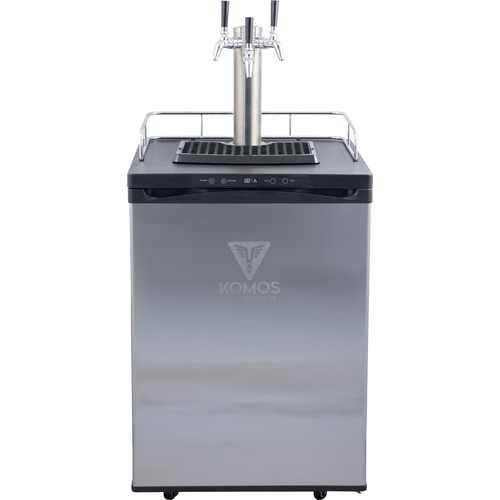
The upside of kegging beer is that you can skip the step of bottle conditioning. Your kegged beer can be ready to drink more quickly and it is much easier to control the level of carbonation.
The downside of kegging beer is that it becomes much less portable. You can’t share it with friends unless you’re entertaining them at your house. You can’t toss it in a cooler and take it to a picnic in the park. And, in this case, we want to deliver a few bottles of our currently kegged beer to a homebrew competition. So today we will be bottling beer from the keg.
There is purpose-made equipment for bottling from kegs and we have tried a couple of different methods. Our experiment with the Blichmann beer gun was not a success. It was messy and frustrating and eventually we just gave up on that approach.

The method we’ve settled on to tap the beer from the kegerator directly into chilled, sanitized bottles.
The first step is to chill and sanitize the bottles. We do this with Star San solution to which we add ice. Cold bottles inhibit head formation, so that the carbonation ends up sealed in the bottle and you aren’t pouring a flat beer.

We also sanitize the bottle caps, the tap faucets, and the line through which we will purge the bottles of air with CO2. We set up a line on the kegerator to deliver CO2 gas only. Air is the enemy of beer so we replace the air in the sanitized bottles with CO2 before filling from the tap.

We’ve reduced the pressure so that the beer leaves the tap a bit more slowly, to further reduce foaming while bottling.
Then we fill each bottle from the tap and use the bottle capper to seal. This is when it’s useful to have two people – one filling and one capping. To preserve the carbonation, it’s important to get the cap on as quickly as possible.

For this beer, we found that filling the bottle to when the small amount of foam just reached the top gave us the right amount of consistent head space in each bottle.
Then we wiped down the filled bottles and boxed them up in the case.

Today we bottled a winter-spiced dark Belgian ale for a Belgian-themed homebrew competition at Side Gate. Our beer is a dark, creamy ale, highly carbonated, malty, with a very forward clove flavor. We’ll get competition results at the end of February. Wish us luck!

 Brewbegin
Leave a comment